
January: Selections from the Collection - Books!
Updated: Feb 2
Back-to-School Season… even in the late 19th century!

This week’s archival find is The Franklin Fifth Reader by George Stillman Hillard, c. 1878, a textbook used in public and private American classrooms to teach reading, rhetoric, and public speaking.
Inside this fifth-grade reader, we discovered a handwritten poem by a young student. An inscription on the front reads: “Yeate Terry, Patchogue, LI.” Tucked into the book was a loose sheet of paper, a poem likely written by the student himself:

I am a little boy, you see,
Not higher much than papa’s fence.
Some of the big boys said that I
To make a speech ought not to try.
This raised my spunk and I am here,
Small as to you I may appear.
And though my voice, I know, is meek,
I’ll show these boys that I can speak!
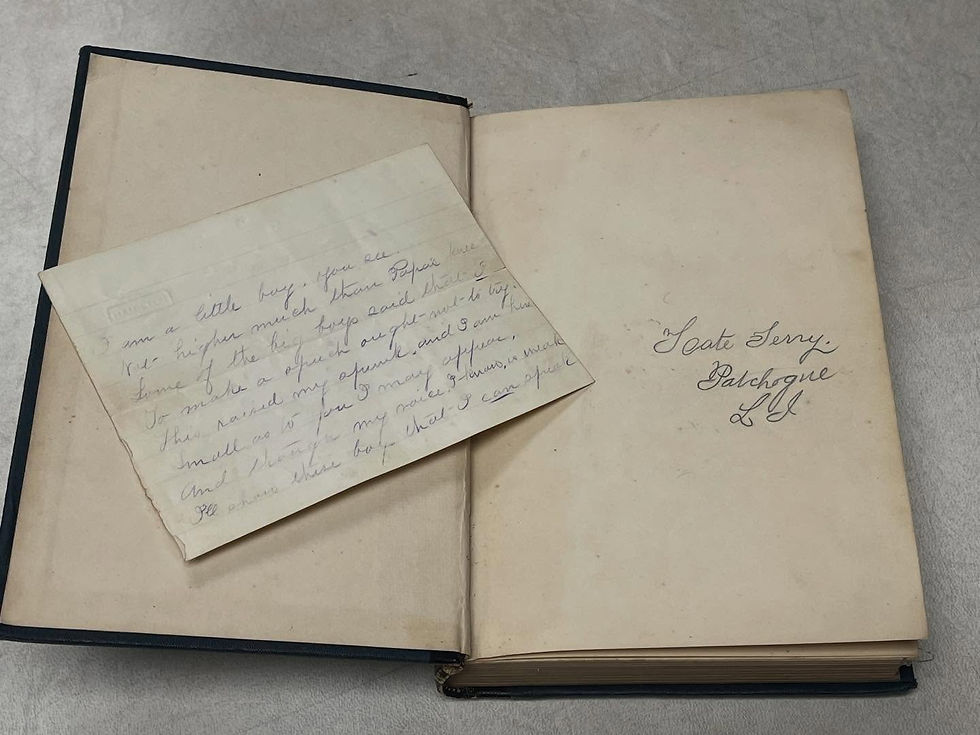
As students continue to head back to school after the holidays, this poem feels timeless, full of nerves and quiet determination!
Archive question for you:
Have you ever looked back at your own old textbooks or notebooks from when you were in school? What stories might they hold?

Last week we explored a handwritten poem tucked inside the 1878 Franklin Fifth Reader.
This week, we turn to an earlier volume in the collection: The Franklin Fourth Reader (1873) by George Stillman Hillard.
Like its other companions, this reader was designed to teach reading and moral awareness through culturally significant texts and original illustrations.
The front cover bears the inscription “Arthur Terry,” and inside we found a small slip of paper with words like “appetite” and “disturbed”, likely part of the student’s vocabulary exercises.

Among the stories included are Louisa May Alcott’s works, featuring her “new boy” character Nat Blake from Little Men.
Also included is Hans Christian Andersen’s The Little Match Girl, a poignant New Year’s Eve tale of a poor, barefoot girl selling matches in the snow.

Archive Question of the Week:
Looking back at the Terry family schoolbooks, what stories, poems, or exercises from your own school days have stayed with you and why do you think they left a mark?
Family Bible of Benjamin Floyd Dominick
C.1858
This family Bible belonged to Benjamin Floyd Dominick, eldest son of George and Sarah H. Dominick, and functioned as both a devotional text and a genealogical record. The handwritten entries within the bible document key moments in the Dominick–Floyd family lineage, offering insight into how nineteenth-century families recorded and preserved their own histories.

Family Bibles such as this one were often maintained over generations and reflect intentional moments when families chose to pause, record, and remember.
The lives recorded in this Bible were rooted in Old Field, where the Dominick family established their homestead and agricultural operation in the mid-nineteenth century.

The Dominick-Crawford Barn, constructed c.1840, functioned as a central working structure within the family landscape and was integral to daily life and labor. The Society’s ongoing Build the Barn project continues this interpretive work by preserving and recontextualizing the barn in which this family’s history unfolded!

Archival Question of the Week
If you had to tell your family’s story using just one object, what would you choose and why?


